Guides
Pricing: the choices that protect a bakery's margin
Owners researching 'bakery pricing guide' need more than a generic checklist. They need to separate food-safety, product, and customer goals from operating.
What to take away
- Set prices from cost, not from a competitor's shelf tag. A typical US artisan loaf carries $2.00 to $2.60 of ingredient, labor and overhead cost and sells near $7.00.
- Write the formula by weight, then divide batch cost by sellable units after shrink and unsold stock.
- Wholesale prices commonly sit 25 to 35 percent below retail, and only work when case packaging, delivery, stale credits and payment terms are priced in.
- Build the menu in tiers: entry, staple, signature, premium. Staples bring traffic and signatures carry margin.
- Review quarterly, and move prices in small steps tied to a documented cost change.
Costing one formula to a number per unit
Unit cost rests on four figures: usable ingredient cost, packaging, direct labor minutes and an overhead rate. Dividing a bag price by guessed portions is where margin disappears.
Costing one formula
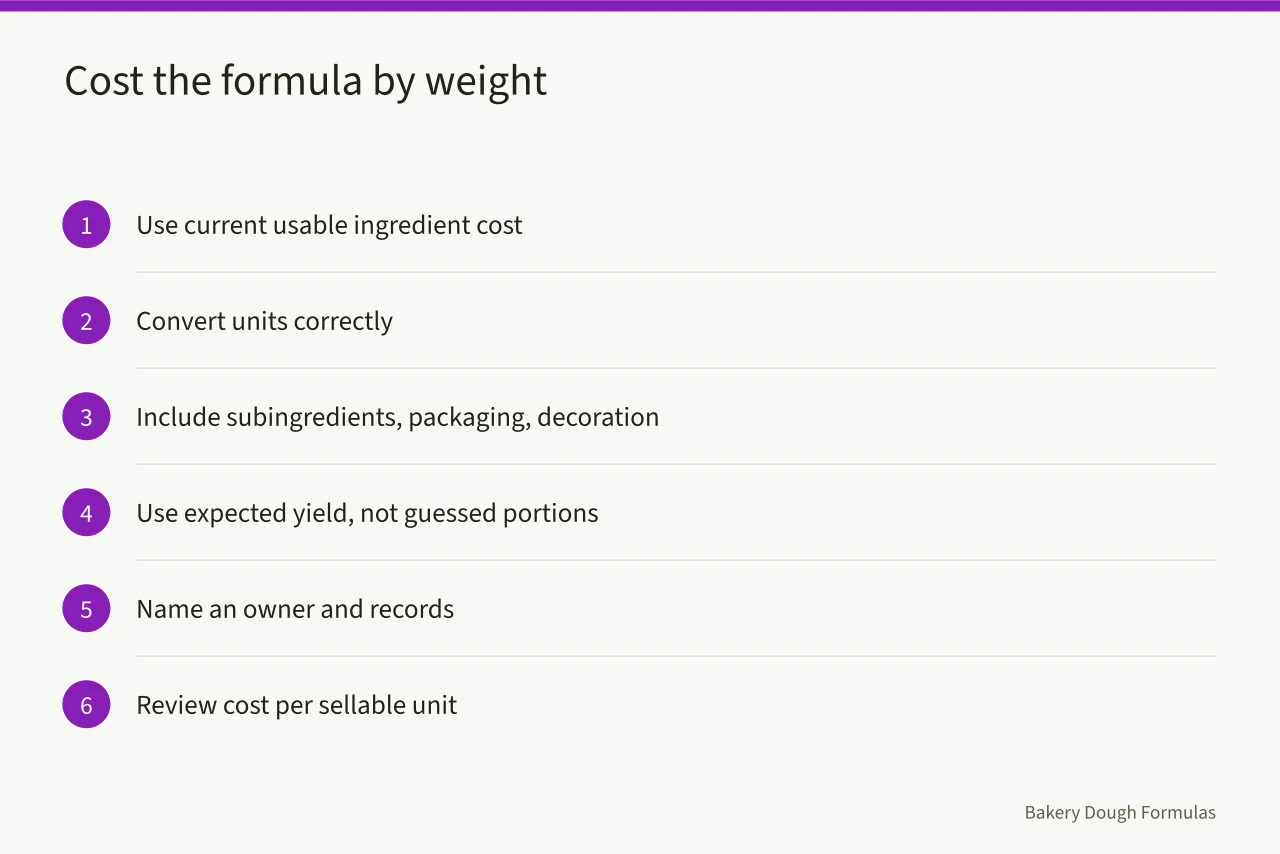
- Write the formula as baker's percentages by weight, with preferments shown as sub-ingredients carrying their own flour and water.
- Price each item at usable costas-purchased price divided by usable yield after trim, spill and spoilage.
- Total the batch, then divide by sellable units after cooling shrink and expected unsold stock.
- Put packaging, label and decoration per unit on the same worksheet.
Baker's percentage holds this arithmetic steady when batch size changes, because every ingredient is a share of total flour weight rather than a fixed scoop. The baker's percentage entry explains scaling and costing use.
Purchase price is only half the cost picture. Sourcing and inventory choices that hold up under demand shows how storage loss, usable yield and supplier terms change the number you enter.
Labor minutes and the overhead rate
Direct labor is hands-on time only: scaling, mixing, dividing, shaping, packing and cleanup between batches. Proof and bake time counts as capacity unless someone must watch it.
Labor minutes and overhead
- Time each step twice, with two different people, and keep the longer figure.
- Use a fully loaded wagebase pay plus payroll taxes, workers compensation and paid breaks.
- Total monthly overheadrent, utilities, insurance, software, merchant fees, licenses, administration, maintenance, marketing.
- Convert overhead into a rate per production labor hour. Small US shops often land between $4 and $8.
Labor minutes per batch divided by units per batch gives labor cost per unit. A 40 minute batch of 12 loaves is 3.3 minutes per loaf, or $1.06 at $19 fully loaded per hour.
Hand-kept rates drift once you sell more than a few products. Software and finance tools compared for a busy bakery shows how to hold cost sheets, invoices and margin reports on one current set of numbers.
Production labor to measure
- Scaling and mixing
- Resting and forming
- Baking and cooling
- Finishing and packing
- Cleaning and setup
- Changeover and supervision
Example: an 800 g sourdough loaf, counter and wholesale
A batch of 12 loaves uses about $7.40 of ingredients, or $0.62 per loaf. Bag and label add $0.40, and a 4 percent waste allowance brings materials to $1.02. Figures are illustrative.
Example: 800 g sourdough
Counter sale
- Price
- $7.00
- Ingredients and packaging
- $1.02
- Direct labor
- $1.06
- Overhead
- $0.33
- Delivery and credits
- $0.00
- Gross profit
- $4.59
- Gross margin
- 66%
Wholesale account
- Price
- $4.90
- Ingredients and packaging
- $1.31
- Direct labor
- $0.95
- Overhead
- $0.33
- Delivery and credits
- $0.34
- Gross profit
- $1.97
- Gross margin
- 40%
Price = cost per unit / (1 minus target gross margin). At a 65 percent target, $2.41 divided by 0.35 gives $6.89, rounded to $7.00 at the counter and $4.90 wholesale.
Menu tiers and the gaps between them
Choose tiers before choosing single prices. Each tier needs a job and a price gap a customer can see.
Menu tiers and gaps
- Entry, $3.25 to $4.50cookies, rolls, single pastries. Job is trial and add-on sales.
- Staple, $4.75 to $6.50croissants, muffins, small loaves. Job is daily traffic at low labor per dollar.
- Signature, $7.00 to $9.50sourdough loaves, laminated specialties. Job is margin.
- Premium, $11.00 and upcelebration cakes, custom work, gift boxes. Job is profit per labor hour.
Signature prices usually land near 1.5 times the staple tier, and premium near twice. Two tiers within 50 cents of each other flatten the top of the menu.
Bundles move a staple and a signature at one price. Bundling bakery products into packages worth paying more for covers how to set a bundle discount without collapsing the gaps between tiers.
When to raise prices, and by how much
Ingredient commodity prices move faster than finished food prices. The Producer Price Index tracks those commodity changes and gives the quarterly review a documented reason.
When to raise prices
- Week 1update invoice prices and rerun margins on your 20 best sellers.
- Week 2change prices on the products that fell below target and leave the rest alone.
- Week 3watch unit counts and customer comments by product, not by store total.
- Week 4keep, adjust or reverse, and date the decision.
Change 2 to 5 percent per product family. A single move of 10 percent or more invites customers to notice.
Records and rules that touch pricing
Keep the paperwork behind every number. The IRS expects records that clearly show income and expenses and support purchases, payroll and assets, which is where your cost sheets belong. Its recordkeeping guidance is the starting point.
Menu labeling rules and small-business nutrition exemptions come from the FDA and depend on outlet count and volume. Confirm current thresholds before printing a nutrition claim.
Pricing paperwork overlaps with permits and labels. Licensing and compliance steps a bakery must clear before opening lists the registrations that decide what you may print and charge.